Advancing treatments for rare diseases together

News

16Mar

The first clinical study of Rimeporide in boys with Duchenne Muscular Dystrophy (DMD), the RIM4DMD study, has been completed. The study examined the safety, tolerability and pharmacokinetic of Rimeporide, in patients aged 6 to 11 years affected by DMD. Effects on serum and imaging biomarkers were also explored. This RIM4DMD study started in March 2016 in 4 clinical centres in Europe: San Raffaele Hospital (Milano, Italy), Armand Trousseau Hospital/ I-motion (Paris, France), Great Ormond Street Hospital (London, UK) and Santa Creu i Sant Pau Hospital (Barcelona, Spain). The enrolment of 20 patients was completed in December 2017.

The patients received Rimeporide orally for 4 weeks. 4 dose levels were tested, in 4 ascending cohorts with 5 patients taking the drug at each dose level. The decision to progress to the next higher dose was made after review of safety and tolerability data for the preceding dose by an independent Safety Monitoring Committee (SMC).

Good tolerability was demonstrated in all dose cohorts, confirming the results obtained previously in adult subjects. Detailed analysis of the study results is ongoing.

EspeRare is engaging discussions with key opinion leaders in neuromuscular diseases and cardiomyopathy in order to design a phase II /III study which should start at the end of 2018/early 2019, depending on funding.

EspeRare would like to thank the patients and their family for their participation, all the clinicians and clinical sites’ staff for all the work done, as well as the patients organisations for their scientific and financial support, e.g. AFM-Téléthon, Altrodomani Onlus association in Italy, Duchenne Parent Project Italy and Duchenne Parent Project Spain.

08Mar

The ella fund will support the development of EspoiR-005 (ER-005) in cancers affecting children.
This initial endowment will fund a series of proof-of-concept screening studies to better characterize ER-005 effects in childhood cancers. To this end EspeRare is collaborating with the Centre Léon Bérard in Lyon, France, a cancer referral and treatment centre and research institute specialised in rare tumours, comprising a paediatric hemato-oncology unit.

Our new therapeutic candidate is a first-in-class candidate for the treatment of rare paediatric cancers. EspeRare obtained the rights to that molecule from a pharmaceutical partner and gained access to the results of previous studies on that compound, including safety and efficacy in humans.

Vast progress has been done in cancer treatments over the last years, however cancers affecting children have not received the same attention from the industry. In view of the severe unmet needs for these underserved young patients, should this initial research phase supported by the ella fund produce promising results, EspeRare intends to rapidly progress the development of this therapy into patients.

About The ella fund

The ella fund is a philanthropy fund sheltered by the Swiss Philanthropy Foundation that seeks to empower girls and women through education, healthcare and entrepreneurship. With this goal in mind they have recognised EspeRare as a promising venture philanthropic drug development organisation led by women.

27Feb

The UK-based organisation Findacure invited EspeRare to present its innovative model at a conference on drug repositioning. This annual event brings together in London major stakeholders in the field (patient groups, clinicians, researchers and life sciences professionals)  on the occasion of World Rare Disease Day. This is a unique opportunity for all these actors to discuss the latest advances in drug repositioning as a source of future treatments for rare diseases.

Caroline Kant, EspeRare's CEO, will explain the philanthropic venture model and how it accelerates the development of treatments for rare diseases. Click here for details on her presentation.

Picture credit: Barbara Asboth

22Dec

The Fondation Pictet financially supports EspeRare’s new programme in a disabling and rare skin disease called X-Linked Hypohidrotic Ectodermal Dysplasia (XLHED). EspeRare is honoured that such a prestigious foundation acknowledges this new project, designed to cure the most threatening symptoms of this disease.

XLHED is a serious rare disease that is life-threatening, particularly in the first years of life. Infants affected by this genetic disorder cannot sweat and are at risk of sudden death due to hyperthermia and severe respiratory issues. See here for more information on the disease.

This new programme, called EspoiR-004 (ER-004) is the first and only therapy for this disease. It is also one of the first treatments designed to be delivered in-utero, paving the way for other such treatments.


24Nov

In its 24 November 2017 edition, the economic magazine of Bilan devoted a section to philanthropy for research in Switzerland.

EspeRare is featured in an article about the muliple ways to do Philanthropy in the research area. The interview with Caroline Kant, CEO of EspeRare, emphasises the urgency of finding accessible treatments to impact the lives of children with rare diseases. She then explains how the foundation's philanthropic venture model allow to accelerate to fight for rare diseases.

30Oct

On the occasion of the 10th anniversary of its TV show Toutes Taxes Comprises (TTC), the Swiss TV channel RTS carried out a report on the Health Valley Switzerland.
EspeRare illustrates, alongside Sophia Genetics and Mindmaze, the diversity, complementarity and dynamics of this ecosystem.

The Health Valley Switzerland, whose name is inspired by Silicon Valley in the USA, is a grouping of biomedical companies from French-speaking Switzerland. The network involves public and private research centres, companies and start-ups working in biomedical technologies, as well as hospitals and clinics. It includes more than 1,000 member companies and 25,000 employees. The Health Valley fosters interaction among its members, and gives international visibility to the biomedical expertise of French-speaking Switzerland.


04Oct

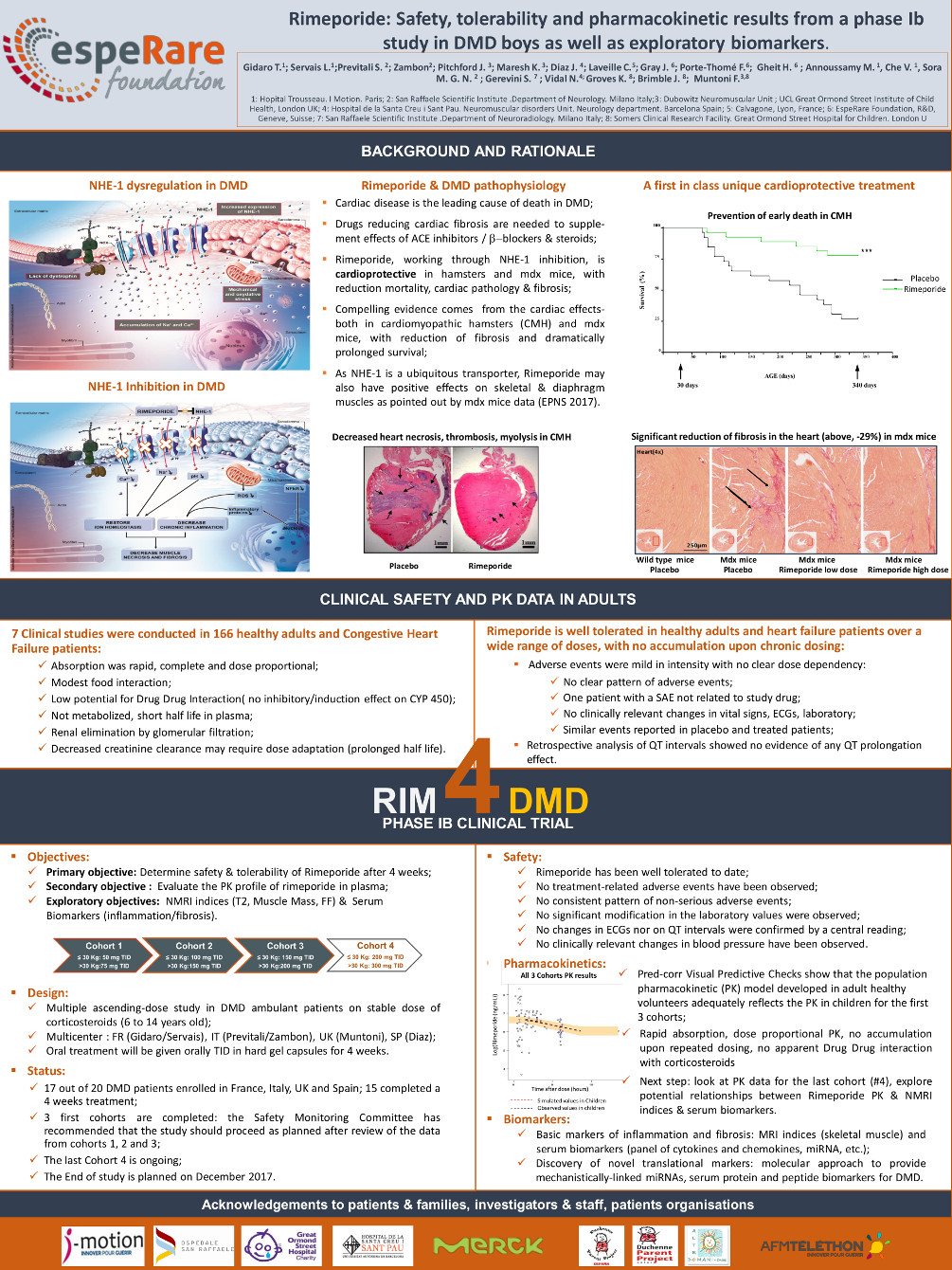
The last advances of the Rimeporide clinical study have been presented at the 22nd World Muscle Society congress, in St Malo. Numerous scientists and physicians have shown interest for this project.

Enrollment into this phase IB clinical trial should be complemented by the end of the year. Full results should be available during the first quarter of 2018. EspeRare is initiating discussions with  worldwide clinicians in order to design the phase II study which should start during 2018, depending  on funding.

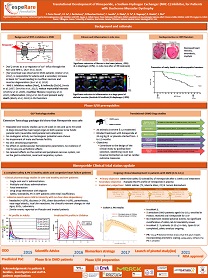
Poster presented at the World Muscle Society congress


26Sep

The Food and Drug Administration (FDA), the US Department of Health and Human Services, has granted an Orphan Drug Designation (ODD) for Rimeporide for the treatment of Duchenne muscular dystrophy (DMD). See here for more details.

ODD is designed to promote the development of drugs that may provide significant benefit to patients suffering from rare, life-threatening diseases. In particular, this ODD grants Rimeporide a 7-year data exclusivity in the US.

Rimeporide already received ODD in DMD from the European Medicines Agency in 2015. Further to this designation in Europe, EspeRare has been able to conduct a phase Ib clinical trial of Rimeporide on young DMD patients. This clinical trial will be completed by the end of 2017.

12Jul

In parallel of developing Rimeporide for the treatment of Duchenne muscular Dystrophy, EspeRare is now also initiating studying Rimeporide's therapeutic potential in Pulmonary Arterial Hypertension.

Rimeporide is a discontinued heart failure drug, that EspeRare has turned into an innovative first-in-class treatment for patients with Duchenne Muscular Dystrophy (click here to check this clinical development programme). Rimeporide has proven to be well-tolerated in multiple animal models and clinical trials in healthy adults and young boys with Duchenne.

 The mechanism of action of Rimeporide, the inhibition of a protein called NHE-1, holds potential in multiple therapeutic indications and EspeRare is working towards establishing collaborations with world-class partners to explore this potential.

 In particular, EspeRare started a collaboration with Larissa Shimoda, Ph.D. and John Huestch, M.D. at the John Hopkins University School of Medicine in the "Division of Pulmonary and Critical Care Medicine". The aim of this collaboration is to explore the therapeutic potientiel of Rimeporide in Pulmonary Arterial Hypertension, using in vitro and in vivo models. Over the last 10 years, this team has published important research articles on the contribution of NHE-1 in the development of this debilitating disease and the use of NHE-1 inhibitors to prevent it.

Positive results from this study would support the initiation of a Phase II clinical trial to test Rimeporide’s therapeutic potential in patients with Pulmonary Arterial Hypertension.

07Jul

EspeRare is currently looking to re-launch the development of ER004 (formerly known as EDI200) as a treatment for babies affected by X-Linked Hypohidrotic Ectodermal Dysplasia (XLHED).

XLHED is a serious rare disease that is life-threatening, particularly in the first years of life. Infants affected by this genetic disorder cannot sweat and are at risk of sudden death due to hyperthermia and severe respiratory issues. See here for more information on the disease.

ER004 is the first and only therapy for this disease. ER004 was developed until 2015 by Edimer Pharmaceuticals (US). Unfortunately its development was stalled following a clinical setback as the treatment, when administered to newborn babies, did not seem to provide therapeutic benefits.

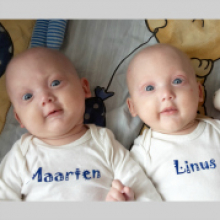
In the meantime, Prof. Holm Schneider, a German medical expert, renewed hope for XLHED patients. When he administered ER004 in-utero to 3 babies (including Maarten & Linus, the babies in the picture), he could show that these patients were subsequently able to sweat normally. These results highlight the strong potential for this therapy, when administered during pregnancy, to address the most debilitating aspects of XLHED. See here for more information on Maarten and Linus.

Using Prof. Holm Schneider’s promising new in-utero approach, EspeRare is now restarting the development of this promesing therapy. Currently, the main hurdle to overcome is to find the right regulatory and funding path forward. Once those challenges are addressed, clinical development in Europe is set to restart as early 2018.

Importantly and in-line with our patient-centered approach, EspeRare is partnering with XLHED patient associations, such as the American organisation NFED, to better understand the patients needs and their expectations from a therapy. See here for news from NFED.

Together with our partners, we are working very hard to ensure a way forward for this ground-breaking treatment. We hope to be able to share more exciting news on this program soon!

22Jun

Prof Muntoni is the Principal Investigator of the multicenter european phase Ib clinical study in Duchenne Muscular Dystrophy boys. He presented Rimeporide in an oral communication at the 12th European Paediatric Neurology Society Congress in Lyon on June 22nd.


On this occasion he gave an update on the preclinical and the clinical development of this innovative treatment that addresses in particular the life-threatening cardiac damage in Duchenne Muscular Dystrophy patients.

16Jun

EspeRare President’s TedMed talk in now online.

In this inspiring speech, Sharon Terry shares her personal story about how, since science didn’t understand her kids’ rare disease, she and her husband decided to study it themselves. Thus they paved the way for patient empowerment in research and drug development.


14Jun

Prim’enfance is a Swiss non-profit foundation focused on understanding, preventing, detecting and treating diseases arising in early infancy .

During an event celebrating the foundation’s 10th anniversary held at the Geneva Hospital (HUG), Prim’enfance has awarded EspeRare a grant for its FloWatch project. EspeRare is delighted and honored to patner for the first time with Prim’Enfance, joining forces to bring health to children born with severe heart defects with the FloWatch project.

20Apr


EspeRare's Annual Report for 2016 has just been published.
The Annual Report highlights the foundation's achievements for 2016 and its financial statements.
 
Click here to read our new Annual Report.


27Feb

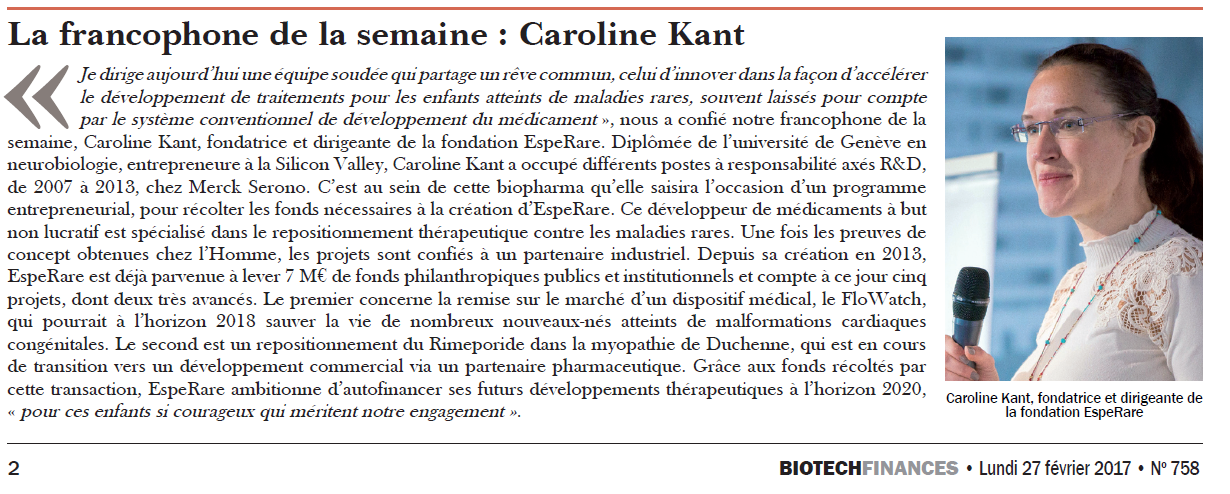
For its issue "Special rare diseases", the journal Biotech Finances has chosen to feature EspeRare's CEO, Caroline Kant.The interview summarises Caroline Kant's career path as well as EspeRare's aims, realizations and business plan, thereby informing finance and biotechs specialists of EspeRare's unique business model.

http://www.eei-biotechfinances.com/

03Feb

With this financial support, AltroDomani Onlus and Parent Project Onlus associations contribute to EspeRare’s first sponsored clinical study conducted with Rimeporide in patients with DMD in Europe (RIM4DMD). This support will provide financial back up for the follow-up of patients who participate in this clinical trial in Italy and facilitate the organisation of the travel and accommodation of these patients and their families during their study visits at the hospital.

The RIM4DMD clinical study was initiated in June 2016 at the San Raffaele Hospital in Milano where Dr Stefano Previtali is the principal investigator. Recruitment at this site is ongoing.
 
The study is also open for recruitment in 3 other clinical centres in Europe: the Santa Creu i Sant Pau Hospital (Barcelona, Spain), the Armand Trousseau Hospital/ I-motion (Paris, France) and the Great Ormond Street Hospital (London, UK).

To find out more about EspeRare's RIM4DMD clinical project, please click here.

To find out more about AltroDomani Onlus, please click here.

To find out more about Parent Project Onlus, please click here. And to read this news on Parent Project Onlus' website, please click here.

01Dec

EspeRare is on screen in UBS branches to promote social innovators.

To find out more about this UBS programme, click here.

16Nov

EspeRare is delighted to add a new program to its portfolio and to announce the relaunch of a previously marketed active implantable medical device, FloWatch.  EspeRare recently obtained the licensing rights to this clinically-proven device that has medical benefits in protecting the heart and lungs of babies born with severe congenital heart defects. This is EspeRare’s first “medical devices” program, adding diversification to our present portfolio of 4 therapeutic drug programs. This is also EspeRare’s first, market-ready therapeutic intervention. EspeRare’s medical devices team is working hard to have the first FloWatch units manufactured and marketed before the end of 2017.

FloWatch is a technology that could be offered to up to 1000 babies per year in Europe and to over 30,000 in Africa and Asia. In these latter regions, and in line with EspeRare’s ethical goals of universal access to medicine, we are evaluating a distribution model for FloWatch that is socially responsible, maximizes medical impact, and whereby profits made from the FloWatch sales in the developed countries support philanthropic distribution in the poorer countries.

Find out more about the FloWatch programme

Find out more about Congenital Heart Defects

Find out more about the FloWatch device


05Oct

EspeRare is presenting its latest update on the clinical development of Rimeporide in Duchenne Muscular Dystrophy, "Translational Development of Rimeporide, a Sodium-Hydrogen Exchanger (NHE-1) Inhibitor, for Patients with Duchenne Muscular Dystrophy", at the 21st International Congress of the World Muscle Society in Grenada (Spain), October 4th to 8th.

rimeporide_esperare_WMS2016Click on picture to view

For more information on the WMS 2016 congress click here

05Aug

EspeRare is pleased to announce a collaboration between Duchenne UK, a Duchenne patient organisation, and Professor Dominic Wells at the Royal Veterinary College, to test a potential new anti-inflammatory and anti-fibrotic therapy on the mdx mouse model for Duchenne Muscular Dystrophy (DMD).

Duchenne UK is providing £67,980 to fund an eight-month program that will assess the potential benefits of EspeRare’s ER03 compound in DMD. This preclinical studies will look at the scientific rationale to “re-position” the compound as a treatment for DMD.

This compound has already been tested in several animal models of inflammation and fibrosis. It has also been tested for safety in healthy volunteers, in several Phase I studies as well as in a Phase II study.

Those living with Duchenne lack the muscle protein dystrophin which acts as a ‘shock absorber’ for muscle. Without a shock absorber, everyday use of muscles cause them to become damaged. This damage promotes inflammatory processes which in turn cause hardening and scar formation. Muscles damaged in this way are termed fibrotic. It is hoped that this potential new therapy will be effective in treating both inflammation and fibrosis in the damaged muscles of those living with Duchenne. This would be a treatment for all those living with Duchenne, regardless of their age or DMD gene mutation.

If this research program shows promise, the compound will be able to go straight to a Phase II Proof of Concept study in DMD patients. In line with our commitment to repositioning existing drug and bring medicines to market in an accelerated way, Duchenne UK and EspeRare are committed to further develop this treatment in Phase II, if the compound shows efficacy.

Emily Crossley and Alex Johnson, Co-Founders of Duchenne UK, said; “We are delighted to be able to join forces with Esperare and the Royal Veterinary College, to confirm the efficacy in DMD and advance our knowledge about this compound. By leveraging on the available data package and capitalizing on its safe use in humans in previous studies, we hope that if it shows promise, we could go into patients with DMD as soon as early 2018.

Florence Porte, CSO of EspeRare said: “Thanks to the generosity of Duchenne UK, it has been possible to transform this shelved asset into a potential novel therapeutic option for patients with DMD. This innovative repositioning approach may offer to patients with DMD a new and safe disease modifier addressing inflammation and fibrosis and which may be combined with dystrophin replacing therapies.

For more about Duchenne UK -> link

Duchenne UK news release -> link

For more about Royal Veterinary College -> link

Pages